

Dolomites Ski Touring: Your Questions Answered
Written by Max Balmford
19th August 2026
Dolomites Ski Touring: Your Questions Answered
We asked Mountain Tracks guide and Dolomites local, Guido, what it’s really like to ski tour hut-to-hut through the Dolomites, from the skiing and scenery to the famous rifugi, fitness required and what to pack.
Why are the Dolomites so good for ski touring?
The Dolomites offer something slightly different from classic ski touring in the Western Alps. The terrain is generally broad and varied rather than seriously steep, with plenty of options for adapting a day to the group, the weather and the snow conditions.
That makes the Dolomites particularly interesting for groups with mixed abilities.
There are challenging sections for experienced tourers, but there are also easier alternatives when conditions or energy levels dictate.
And then there is the scenery.
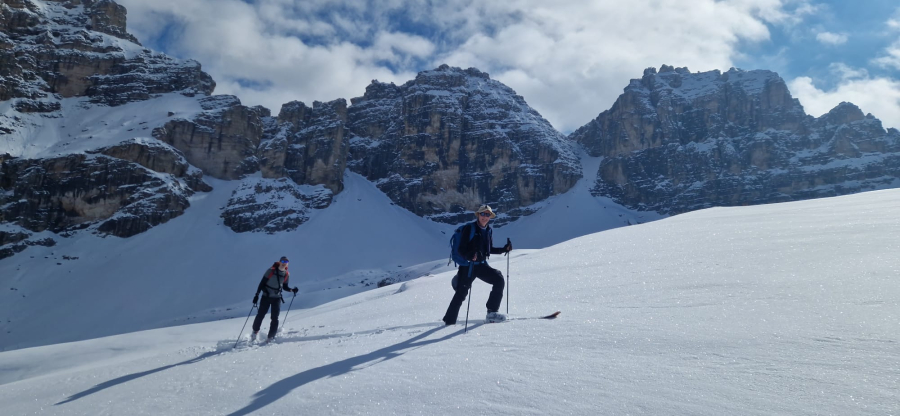
Guido has guided the circuit countless times, but the enormous limestone walls and towers still make an impression,
“it’s a fantastic, incredible, unique panorama.”
How difficult is the Dolomites Circuit?
One of the great things about the Dolomites Circuit is its flexibility.
The route has options, meaning it can work for a wide range of ski tourers. Guido wouldn't necessarily recommend it as someone's very first ever ski touring experience, but people with relatively limited touring experience can enjoy it if they have the right skiing and fitness base.
For more experienced tourers, there are opportunities to make days longer or more challenging.
The most important thing isn't necessarily being an exceptional off-piste skier, but being comfortable on your skins. Much of the skiing is in wide, relatively forgiving terrain. The trickier sections tend to come during the uphill journey rather than on the descent.
How fit do you need to be?
The typical days involve around 600–1,000m of ascent, with some days towards the upper end of that range.
The important thing is to be comfortable spending a full day moving through the mountains.
You don't need to be an elite athlete, but you should have a good base level of fitness and be prepared for several hours of touring, transitions and skiing. A full day’s hill walk, a half-marathon, or a 50 mile cycle ride would all be achievable.
The circuit builds through the week. After an easier first day, the second day involves around 700–1,000m of ascent, followed by days of around 1,000m.
What is the skiing like?
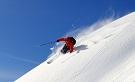
Despite the spectacular mountain scenery, the skiing itself isn't generally extreme.
Most of the descents are through wide, open terrain, with some sections through trees and more widely spaced woodland. This is what makes it such a good first step into Hut-to-Hut touring.
There is one short steeper section on the way from Fanes to Sennes which can reach around 35 degrees, but Guido describes it as short and relatively straightforward even for less confident skiers.
The more technical part of that day is actually the uphill traverse.
There can be steeper skinning, kick turns and, depending on conditions, a short section where crampons are useful. We have a training day to hone and remind ourselves of these skills.
What does a typical day look like?
The trip starts relatively gently, combining off-piste skiing with easy skinning before using the lift to reach the first hut, the Rifugio Lagaziou. From here, the days become progressively more adventurous.
You can expect around 1000m of ascent or less a day, and depending on the group, there are options to add more ascent and skiing, or take simpler routes.
The approach to Rifugio Fanes is one of Guido's highlights, with views of Monte Cjaval on the descent.
The most technical element is on Day 4, and this is an ascent, with some steeper skinning and kick turns. Depending on the snow, crampons may be needed for one of the cols. The crampon section can be as little as 10–15 minutes and isn't as serious as high-alpine mountaineering.
The downhill sections are generally 35 degrees or less. That said, mixed and variable conditions can be expected.
What happens if the snow isn't good?
This is where having Guido’s experience is very helpful! When touring, the itinerary is never a rigid route.
If the snow is poor, Guido and the guiding team look for alternatives - including tree skiing or different itineraries - to make the most of what the mountain is offering.
Likewise, if the group is tired or the weather deteriorates, there are often easier options between huts.
What are the mountain huts like?
Guido struggles to choose a favourite because, in his words, he think's they are all “5-star.” And stresses, not a Swiss, or French, but an Italian 5*.
The Rifugio Lagazuo is the first hut on our route and has the most spectacular setting and views. The accommodation is a little more basic than those to follow but still has WiFi, showers, charging areas. At this Hut, it’s all about the location.
The Rifugio Fanes is another level again, Guido describes it as being “really like a hotel”. The rooms are comfortable, the dining room is large, and there are good, spacious lockers for your skis and boots.
The Rifugio Sennes is a little quieter and less crowded but maintains the same high standard.
Across the huts, you can expect excellent service, great food and comfortable accommodation. There is Wi-Fi, showers are generally available, and if you're lucky the hut guardian might even play some local instruments in the evening.
Food is a surprisingly important part of the experience on a hut-to-hut tour, particularly after several hours of climbing and skiing, and the Huts in the Dolomites do it exceptionally well.
You don't need to carry a week's worth of food in your rucksack either. Generous portions and snacks are available to purchase in the huts, and marching tea is readily available throughout the tour.
After a full day of ski touring, you will find these Huts are a pretty good place to finish, and we don’t think it can be beaten anywhere across the Alps for hospitality and standard of accommodation.
What should you pack for the Dolomites Circuit?
One of Guido's biggest pieces of advice is simple: Don't bring too much.
People tend to overestimate how much they need, particularly when it comes to food and clothes for the Huts.
Essential equipment includes:
- Touring skis, boots, bindings and skins
- Ski crampons – mandatory
- Avalanche transceiver, shovel and probe
- Helmet
- Suitable clothing for full days in winter conditions
- A lightweight ice axe, depending on conditions (can be rented in resort)
- Boot crampons (can be rented in resort)
- Sleeping bag liner
- Small headtorch
You don't need a harness for the circuit.
Boot crampons may be required depending on conditions, but if you've never used them before, don't be put off. The sections where they're used can be short, and crampons can be rented if necessary.
For clothing and personal kit, think light. One or two spare shirts and pairs of socks, a small towel and the basics are enough. Slippers are provided by the Huts.
Upon booking, a full kit list will be provided detailing exactly what you will need.
Do you need to be an experienced mountaineer?
No, and this is something Guido is keen to emphasise.
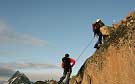
There are some sections where crampons or an ice axe may be used, but the trip isn't a high-mountain mountaineering expedition. There is no harness required, and the technical sections are generally short.
The biggest requirements are much simpler, be reasonable off-piste skier (at our Intermediate level), have prior touring experience, and have a good solid level of fitness for full days in the mountains.
What is the best part of the Dolomites Circuit?
That's difficult to answer because it depends on what you're looking for.
The Lagazuoi is an obvious highlight for the views, particularly because it is your first hut and gives you that immediate sense of where you are.
The journey from Fanes to Sennes provides some of the more technical touring and is one of the most rewarding days for experienced tourers.
But perhaps the best answer is simply the combination. As Guido says:
“If the snow is good, then the skiing is good, with the Huts we have, then it's more than enough.”
And after spending thousands of days guiding in the Dolomites, that's a pretty convincing recommendation.
Is the Dolomites Circuit right for you?
This trip is a great fit if you're:
- A confident intermediate/advanced off-piste skier
- Already comfortable using touring equipment
- Happy spending 5–8 hours in the mountains
- Fit enough for around 600–1,000m of ascent
- Comfortable carrying a touring pack
- Keen to experience hut-to-hut ski touring
- Looking for spectacular scenery as much as great skiing
You do need a good base level of fitness and a willingness to walk uphill.
Ready to ski the Dolomites?
The Mountain Tracks Dolomites Circuit is a five-night hut-to-hut ski tour through some of the most spectacular terrain in the Italian Alps, with an experienced mountain guide leading the way.
 Travel Website Development